Why Choose Us?
One-stop solution
Zhejiang Fengfu Pharma Co.,Limited engaged in the development, production and marketing of pharmaceutical products, food ingredients, vitamins, intermediates and chemicals.
Rich experience
Fengfu Pharma,headquartered in Hangzhou, China, with 3 production bases in Shandong, Zhejiang and Hebei separately, which have many years of experience in the production of APIs, vitamins and chemical products. These facilities have been certified GMP, ISO, FAMI-QS, KOSHER, HALAL, etc.
High quality
We have complete control over our product development, design, and manufacturing processes, thanks to our advanced equipment, methods, and inspection facilities.
High quality service
Our goal is to provide you with quality products and professional services for mutual benefit. We are also willing to work with partners around the world to create a better future together.
Lidocaine Hydrochloride is the hydrochloride salt form of lidocaine, an aminoethylamide and a prototypical member of the amide class anesthetics. Lidocaine interacts with voltage-gated Na+ channels in the nerve cell membrane and blocks the transient increase in permeability of excitable membranes to Na+. This prevents the generation and conduction of nerve impulses and produces a reversible loss of sensation. Lidocaine hydrochloride also exhibits class IB antiarrhythmic effects. The agent decreases the flow of sodium ions into myocardial tissue, especially on the Purkinje network, during phase 0 of the action potential, thereby decreasing depolarization, automaticity and excitability.

Polymyxin B Sulfate CAS 1405-20-5
Product: Polymyxin B Sulfate CAS 1405-20-5
Chemical Name: Polymyxin B, sulfate (salt); Polymyxin B; Polymyxin-B-Sulfat; Sulfato De Polimixina B; Polymyxin B (PMB); PMB; Polymyxin B sulfate USP; Polymyxin B Sulfate 1405-20-5; Einecs 215-774-7;
CAS No.: 1405-20-5

Parecoxib Sodium CAS 198470-85-8
Product: Parecoxib Sodium CAS 198470-85-8
Alternative Name: Parecoxib Sodium; Parecoxib; Parecoxib Sodium API; Parecoxib Sodium API;
Chemical Name: 4-(5-methyl-3-phenyl-4-isoxazolyl)benzenesulfonamide sodium salt
Molecular formula: C19H18N2O4S·Na
Molecular mass: 392.409

Vonoprazan Fumarate CAS 1260141-27-2
Product: Vonoprazan Fumarate TAK-438
Another name: TAK438; TAK-438
CAS No.: 1260141-27-2
Application: It effectively terminates the secretion of gastric acid, thereby achieving acid suppression
Product Category: Gastrointestinal API, Pepsin digestive enzyme API, Pancreatin digestive enzyme API
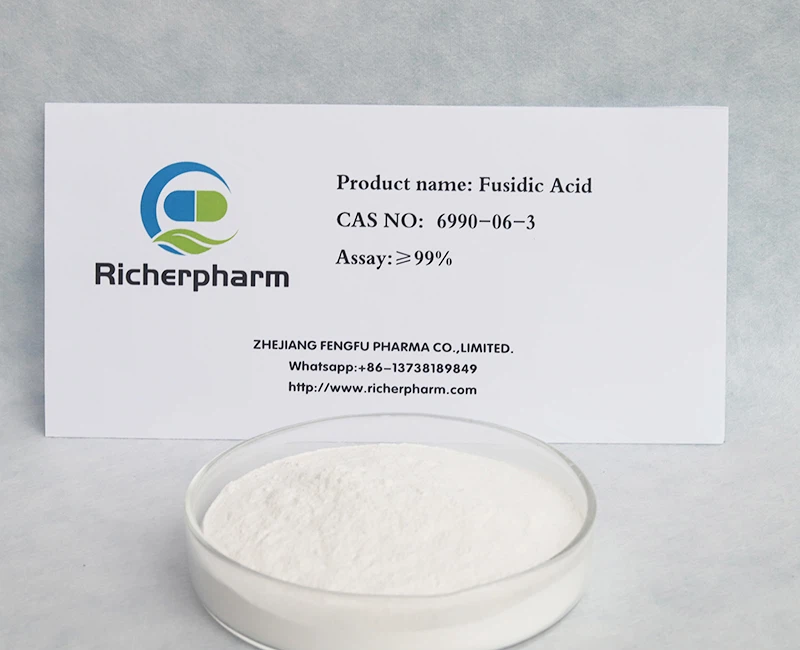
Product: Fusidic Acid 6990-06-3
Chemical Name: Fusidic acid; Fusidic Acid API; Fusidic Acid Active Pharmaceutical Ingredient; CAS 6990-06-3; Acide Fusidique; Acido Fusidico; 6990-06-3;
CAS No.: 6990-06-3
Physical characteristics: white powder
Molecular Formula: C31H48O6·1/2 H2O

Vonoprazan Fumarate CAS 881681-01-2
Product: Vonoprazan Fumarate CAS 881681-01-2
Chemical Name: 1-(5-(2-Fluorophenyl)-1-(pyridin-3-ylsulfonyl)-1H-pyrrol-3-yl)-N-methylmethanamine fumarate
Another name: TAK438; TAK-438; MFCD18633280; 1260141-27-2 TAK-438 AKSci J97352; Fumarat Vonoprazana; Vonoprazan Fumarate-D3; N-methyl-1-(3-pyridyl sulfonyl)-1H-pyrrole-3-methanamine; 1-(5-(2-Fluorophenyl); AB457904 CAS 881681-01-2;

Product: Sodium Fusidate CAS 751-94-0
Chemical Name: Fusidate De Sodium; Fusidato De Sodio; Fuzydyt Alsudium; Natriy Fuzidat; 751-94-0; Fucidina; Fucidine; Fusidatesodium; Fusidin; Fusin; Intertullefucidin; Sodium fusidate reference substance;
CAS No.: 751-94-0
Physical characteristics: A white crystalline powder, and the solvent is a colorless clear liquid.

Product: Bacitracin Zinc CAS 1405-89-6
Another Name: Bacitracina De Zinc; Batsitrazin Tsink; Bacitracina De Zinco; CAS 1405-89-6; 1405-89-6;
Physical characteristics: Pale yellow to brownish-yellow powder; odorless with a bitter taste.
Molecular formula: C66H103N17O16SZn

Product: Lincomycin HCL CAS 859-18-7
Another Name: Lincomycin Hcl; lincomycin hydrochloride; methyl 6,8-dideoxy-6-{[(4R)-1-methyl-4-propyl-L-prolyl]amino}-1-thio-D-erythro-alpha-D-galacto-octopyranoside hydrochloride; Lincomycin hydrochloride anhydrous; CAS 859-18-7; 859-18-7; Hidrocloruro De Lincomicina; Hidruklurid Allinkomaisin; Lincocin; Lincomix; Lincomycin Monohydrochloride;

Pazufloxacin Mesilate CAS 163680-77-1
Product: Pazufloxacin Mesylate CAS 163680-77-1
Another Name: Pazufloxacin Methanesulfonate; pazufloxacin mesylate; Pazufloxacin MS; Pazufloxacin MSLT; Pazufloxacin Methanesulphonate; 163680-77-1; Pazufloxacin mesilate; Pazucross; Pazufloxacin (mesylate); Pazufloxaxin methanesulfonate; Pasil; T-3762;
Mechanism of Action
Lidocaine hydrochloride stabilizes the neuronal membrane by inhibiting the ionic fluxes required for the initiation and conduction of impulses thereby effecting local anesthetic action.
Hemodynamics
Excessive blood levels may cause changes in cardiac output, total peripheral resistance, and mean arterial pressure. With central neural blockade these changes may be attributable to block of autonomic fibers, a direct depressant effect of the local anesthetic agent on various components of the cardiovascular system, and/or the beta-adrenergic receptor stimulating action of epinephrine when present. The net effect is normally a modest hypotension when the recommended dosages are not exceeded.
Pharmacokinetics and Metabolism
Information derived from diverse formulations, concentrations and usages reveals that lidocaine hydrochloride is completely absorbed following parenteral administration, its rate of absorption depending, for example, upon various factors such as the site of administration and the presence or absence of a vasoconstrictor agent. Except for intravascular administration, the highest blood levels are obtained following intercostal nerve block and the lowest after subcutaneous administration.
The plasma binding of lidocaine hydrochloride is dependent on drug concentration, and the fraction bound decreases with increasing concentration. At concentrations of 1 to 4 mcg of free base per mL 60 to 80 percent of lidocaine hydrochloride is protein bound. Binding is also dependent on the plasma concentration of the alpha-1-acid glycoprotein.
Lidocaine hydrochloride crosses the blood-brain and placental barriers, presumably by passive diffusion.
Lidocaine hydrochloride is metabolized rapidly by the liver, and metabolites and unchanged drug are excreted by the kidneys. Biotransformation includes oxidative N-dealkylation, ring hydroxylation, cleavage of the amide linkage, and conjugation. N-dealkylation, a major pathway of biotransformation, yields the metabolites monoethylglycinexylidide and glycinexylidide. The pharmacological/toxicological actions of these metabolites are similar to, but less potent than, those of lidocaine hydrochloride. Approximately 90% of lidocaine hydrochloride administered is excreted in the form of various metabolites, and less than 10% is excreted unchanged. The primary metabolite in urine is a conjugate of 4-hydroxy-2,6-dimethylaniline.
The elimination half-life of lidocaine hydrochloride following an intravenous bolus injection is typically 1.5 to 2 hours. Because of the rapid rate at which lidocaine hydrochloride is metabolized, any condition that affects liver function may alter lidocaine hydrochloride kinetics. The half-life may be prolonged two-fold or more in patients with liver dysfunction. Renal dysfunction does not affect lidocaine hydrochloride kinetics but may increase the accumulation of metabolites.
Factors such as acidosis and the use of CNS stimulants and depressants affect the CNS levels of lidocaine hydrochloride required to produce overt systemic effects. Objective adverse manifestations become increasingly apparent with increasing venous plasma levels above 6 mcg free base per mL. In the rhesus monkey arterial blood levels of 18 to 21 mcg/mL have been shown to be threshold for convulsive activity.
Lidocaine hydrochloride can be given on as needed or scheduled basis and should be taken as prescribed by your provider. It is important to make sure you are taking the correct amount of medication every time. Before every dose, check that what you are taking matches what you have been prescribed. Never take more than is prescribed.
Use a measuring cup to make sure you have the right amount of viscous lidocaine. This should come with the medication. Do not dilute (mix) with water or any other liquid.
● If you have sores or irritation in your mouth or on your gums, swish the viscous lidocaine all around your mouth. Once your whole mouth is coated, spit out the viscous lidocaine.
● If you have sores or irritation in your throat, you can gargle the viscous lidocaine in the back of your throat and swallow. If you have pain in both your mouth and down your throat, swish the viscous lidocaine in your mouth, then gargle and swallow. Do not take two doses at one time.
● If you have only a few sores in your mouth, you can use a cotton swab to dip into the viscous lidocaine and put the cotton swab right on the sore.
Avoid eating or drinking for at least 1 hour after taking viscous lidocaine. Since your mouth may be numb, you may have trouble swallowing and could bite your tongue or cheek.
Be sure to tell your healthcare provider about all medications and supplements you take. If you are allergic to any numbing medication, tell your provider before taking lidocaine viscous. Tell your provider if you have liver disease or problems with your heart.
In deciding to use a medicine, the risks of taking the medicine must be weighed against the good it will do. This is a decision you and your doctor will make. For this medicine, the following should be considered:
Allergies
Tell your doctor if you have ever had any unusual or allergic reaction to this medicine or any other medicines. Also tell your health care professional if you have any other types of allergies, such as to foods, dyes, preservatives, or animals. For non-prescription products, read the label or package ingredients carefully.
Pediatric
Because of this medicine's toxicity, it should be used with extreme caution in children younger than 3 years of age, only after other medicines have been considered or found ineffective. Recommended doses should not be exceeded, and the patient should be carefully monitored during treatment. Do not give lidocaine viscous topical solution for teething pain.
Appropriate studies have not been performed on the relationship of age to the effects of lidocaine jelly or skin patch in the pediatric population. Safety and efficacy have not been established.
Geriatric
Appropriate studies performed to date have not demonstrated geriatric-specific problems that would limit the usefulness of skin patch in the elderly. However, elderly patients are more likely to have age-related liver, kidney, or heart problems, which may require caution and an adjustment in the dose for patients receiving this medicine.
No information is available on the relationship of age to the effects of lidocaine topical in geriatric patients. However, because of this medicine's toxicity, it should be used with caution, after other medicines have been considered or found ineffective. Recommended doses should not be exceeded, and the patient should be carefully monitored during treatment.
Drug Interactions
Although certain medicines should not be used together at all, in other cases two different medicines may be used together even if an interaction might occur. In these cases, your doctor may want to change the dose, or other precautions may be necessary. When you are taking this medicine, it is especially important that your healthcare professional know if you are taking any of the medicines listed below. The following interactions have been selected on the basis of their potential significance and are not necessarily all-inclusive.
If both medicines are prescribed together, your doctor may change the dose or how often
Using this medicine with any of the following medicines may cause an increased risk of certain side effects, but using both drugs may be the best treatment for you. If both medicines are prescribed together, your doctor may change the dose or how often you use one or both of the medicines.
Other Interactions
Certain medicines should not be used at or around the time of eating food or eating certain types of food since interactions may occur. Using alcohol or tobacco with certain medicines may also cause interactions to occur. Discuss with your healthcare professional the use of your medicine with food, alcohol, or tobacco.
Medicinal benefits
Lignocaine hydrochloride is a pain reliever that is used during specific medical operations (such as putting a tube into the urinary system). It is also used to numb the lining of the mouth, throat, or nose prior to some medical operations (for example, intubation). Lidocaine jelly is also used to treat discomfort caused by urinary tract swelling (urethritis). It works by numbing particular moist parts of the body. Lidocaine is a kind of medication known as a local anesthetic. Lignocaine hydrochloride contains 'lignocaine hydrochloride,' which prevents sodium ions' influx (entry) into the membrane covering the nerves, hence blocking impulse initiation and conduction.
Directions for use
Topical liquid/gel/ointment/jelly: Use it as advised by the doctor. Apply the prescribed dose to the affected area. Spray: Shake the bottle before using the spray. To spray, point the nozzle to the application place and click the button. Even if the container is empty, do not puncture, incinerate, or damage it. Patch: Patch the afflicted area using the patch. Handle the patch with dry hands only. While wearing the patch, avoid bathing, showering, or swimming.
● Storage
● Store in a cool and dry place away from sunlight
● Side effects of lignocaine hydrochloride
● Burning sensation
● Itching
● Redness
● Irritation
The safety and effectiveness of lidocaine hydrochloride depend on proper dosage, correct technique, adequate precautions, and readiness for emergencies. The lowest dosage that results in effective anesthesia should be used to avoid high plasma levels and serious adverse effects. Repeated doses of lidocaine may cause significant increases in blood levels with each repeated dose because of slow accumulation of the drug or its metabolites. Tolerance to elevated blood levels varies with the status of the patient. Debilitated, elderly patients, acutely ill patients, and children should be given reduced doses commensurate with their age and physical status. Lidocaine should also be used with caution in patients with severe shock or heart block.
Lidocaine hydrochloride 2% Jelly should be used with caution in patients with known drug sensitivities. Patients allergic to para-aminobenzoic acid derivatives (procaine, tetracaine, benzocaine, etc.) have not shown cross sensitivity to lidocaine.
Many drugs used during the conduct of anesthesia are considered potential triggering agents for familial malignant hyperthermia. Since it is not known whether amide-type local anesthetics may trigger this reaction and since the need for supplemental general anesthesia cannot be predicted in advance, it is suggested that a standard protocol for management should be available. Early unexplained signs of tachycardia, tachypnea, labile blood pressure, and metabolic acidosis may precede temperature elevation. Successful outcome is dependent on early diagnosis, prompt discontinuance of the suspect triggering agent(s) and institution of treatment, including oxygen therapy, indicated supportive measures and dantrolene (consult dantrolene sodium intravenous package insert before using).
Information for Patients: When topical anesthetics are used in the mouth, the patient should be aware that the production of topical anesthesia may impair swallowing and thus enhance the danger of aspiration. For this reason, food should not be ingested for 60 minutes following use of local anesthetic preparations in the mouth or throat area. This is particularly important in children because of their frequency of eating.
Numbness of the tongue or buccal mucosa may enhance the danger of unintentional biting trauma. Food or chewing gum should not be taken while the mouth or throat area is anesthetized.
Carcinogenesis: Long-term studies in animals have not been performed to evaluate the carcinogenic potential of lidocaine.
Mutagenesis: The mutagenic potential of lidocaine has been tested in the Ames Salmonella reverse mutation assay, and in vitro chromosome aberrations assay in human lymphocytes and in an in vivo mouse micronucleus assay. There was no indication of any mutagenic effect in these studies.
Impairment of Fertility: The effect of lidocaine on fertility was examined in the rat model. Administration of 30 mg/kg, s.c. (180 mg/m2) to the mating pair did not produce alterations in fertility or general reproductive performance of rats. There are no studies that examine the effect of lidocaine on sperm parameters. There was no evidence of altered fertility.
Our Factory
Zhejiang Fengfu Pharma Co.,Limited engaged in the development, production and marketing of pharmaceutical products, food ingredients, vitamins, intermediates and chemicals.
Fengfu Pharma,headquartered in Hangzhou, China, with 3 production bases in Shandong, Zhejiang and Hebei separately, which have many years of experience in the production of APIs, vitamins and chemical products. These facilities have been certified GMP, ISO, FAMI-QS, KOSHER, HALAL, etc. We have complete control over our product development, design, and manufacturing processes, thanks to our advanced equipment, methods, and inspection facilities.
With key competencies in pharmaceuticals and food health, Fengfu Pharma has established extensive business networks around the world. We have Strategic Marketing Partners respectively in Mumbai and Dubai. We are ready to provide you with our best products and services.
Our goal is to provide you with quality products and professional services for mutual benefit. We are also willing to work with partners around the world to create a better future together.

FAQ
Hot Tags: lidocaine hydrochloride cas 6108-05-0, China lidocaine hydrochloride cas 6108-05-0 manufacturers, suppliers, factory, human api for life sciences, human api for technology companies, api for human skill assessment, api for human development data, api for human target audience data, api for human ad response data