Why Choose Us?
One-stop solution
Zhejiang Fengfu Pharma Co.,Limited engaged in the development, production and marketing of pharmaceutical products, food ingredients, vitamins, intermediates and chemicals.
Rich experience
Fengfu Pharma,headquartered in Hangzhou, China, with 3 production bases in Shandong, Zhejiang and Hebei separately, which have many years of experience in the production of APIs, vitamins and chemical products. These facilities have been certified GMP, ISO, FAMI-QS, KOSHER, HALAL, etc.
High quality
We have complete control over our product development, design, and manufacturing processes, thanks to our advanced equipment, methods, and inspection facilities.
High quality service
Our goal is to provide you with quality products and professional services for mutual benefit. We are also willing to work with partners around the world to create a better future together.
Ruxolitinib is used to treat intermediate or high-risk myelofibrosis, including primary myelofibrosis, post-polycythemia vera myelofibrosis and post-essential thrombocythemia myelofibrosis. Myelofibrosis is a life-threatening bone marrow problem which is manifested by the following symptoms: enlarged spleen (splenomegaly), severe itching, fever, night sweats, weight loss, bone pain, or unusual tiredness or weakness. It is also used to treat polycythemia vera in patients who have been previously treated with hydroxyurea that did not work well.
Ruxolitinib is also used to treat acute graft-versus-host disease (aGVHD) in patients who have been treated with other medicines (eg, steroids) that did not work well. It is also used to treat chronic graft-versus-host disease (cGVHD) in patients who have been treated with 1 or 2 previous treatments that did not work well.

Polymyxin B Sulfate CAS 1405-20-5
Product: Polymyxin B Sulfate CAS 1405-20-5
Chemical Name: Polymyxin B, sulfate (salt); Polymyxin B; Polymyxin-B-Sulfat; Sulfato De Polimixina B; Polymyxin B (PMB); PMB; Polymyxin B sulfate USP; Polymyxin B Sulfate 1405-20-5; Einecs 215-774-7;
CAS No.: 1405-20-5

Parecoxib Sodium CAS 198470-85-8
Product: Parecoxib Sodium CAS 198470-85-8
Alternative Name: Parecoxib Sodium; Parecoxib; Parecoxib Sodium API; Parecoxib Sodium API;
Chemical Name: 4-(5-methyl-3-phenyl-4-isoxazolyl)benzenesulfonamide sodium salt
Molecular formula: C19H18N2O4S·Na
Molecular mass: 392.409

Vonoprazan Fumarate CAS 1260141-27-2
Product: Vonoprazan Fumarate TAK-438
Another name: TAK438; TAK-438
CAS No.: 1260141-27-2
Application: It effectively terminates the secretion of gastric acid, thereby achieving acid suppression
Product Category: Gastrointestinal API, Pepsin digestive enzyme API, Pancreatin digestive enzyme API
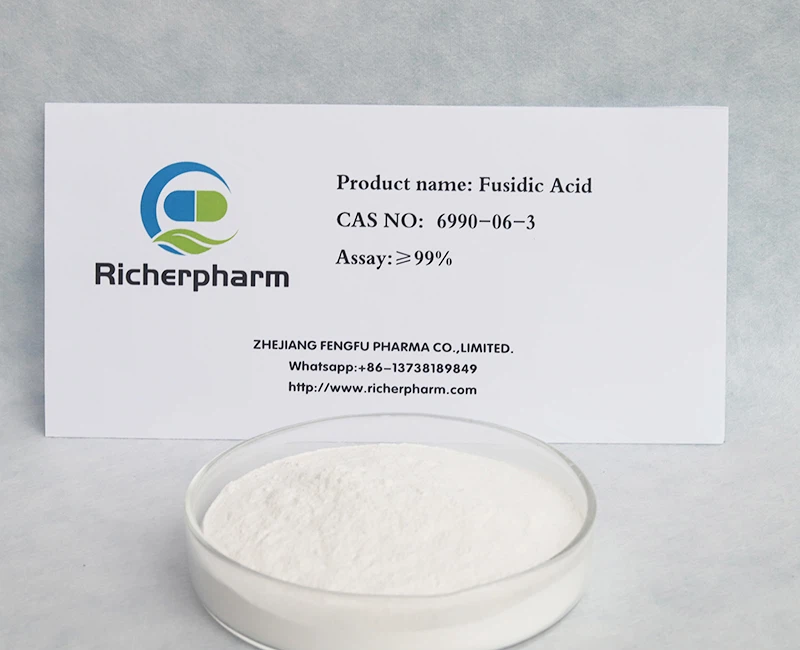
Product: Fusidic Acid 6990-06-3
Chemical Name: Fusidic acid; Fusidic Acid API; Fusidic Acid Active Pharmaceutical Ingredient; CAS 6990-06-3; Acide Fusidique; Acido Fusidico; 6990-06-3;
CAS No.: 6990-06-3
Physical characteristics: white powder
Molecular Formula: C31H48O6·1/2 H2O

Vonoprazan Fumarate CAS 881681-01-2
Product: Vonoprazan Fumarate CAS 881681-01-2
Chemical Name: 1-(5-(2-Fluorophenyl)-1-(pyridin-3-ylsulfonyl)-1H-pyrrol-3-yl)-N-methylmethanamine fumarate
Another name: TAK438; TAK-438; MFCD18633280; 1260141-27-2 TAK-438 AKSci J97352; Fumarat Vonoprazana; Vonoprazan Fumarate-D3; N-methyl-1-(3-pyridyl sulfonyl)-1H-pyrrole-3-methanamine; 1-(5-(2-Fluorophenyl); AB457904 CAS 881681-01-2;

Product: Sodium Fusidate CAS 751-94-0
Chemical Name: Fusidate De Sodium; Fusidato De Sodio; Fuzydyt Alsudium; Natriy Fuzidat; 751-94-0; Fucidina; Fucidine; Fusidatesodium; Fusidin; Fusin; Intertullefucidin; Sodium fusidate reference substance;
CAS No.: 751-94-0
Physical characteristics: A white crystalline powder, and the solvent is a colorless clear liquid.

Product: Bacitracin Zinc CAS 1405-89-6
Another Name: Bacitracina De Zinc; Batsitrazin Tsink; Bacitracina De Zinco; CAS 1405-89-6; 1405-89-6;
Physical characteristics: Pale yellow to brownish-yellow powder; odorless with a bitter taste.
Molecular formula: C66H103N17O16SZn

Product: Lincomycin HCL CAS 859-18-7
Another Name: Lincomycin Hcl; lincomycin hydrochloride; methyl 6,8-dideoxy-6-{[(4R)-1-methyl-4-propyl-L-prolyl]amino}-1-thio-D-erythro-alpha-D-galacto-octopyranoside hydrochloride; Lincomycin hydrochloride anhydrous; CAS 859-18-7; 859-18-7; Hidrocloruro De Lincomicina; Hidruklurid Allinkomaisin; Lincocin; Lincomix; Lincomycin Monohydrochloride;

Pazufloxacin Mesilate CAS 163680-77-1
Product: Pazufloxacin Mesylate CAS 163680-77-1
Another Name: Pazufloxacin Methanesulfonate; pazufloxacin mesylate; Pazufloxacin MS; Pazufloxacin MSLT; Pazufloxacin Methanesulphonate; 163680-77-1; Pazufloxacin mesilate; Pazucross; Pazufloxacin (mesylate); Pazufloxaxin methanesulfonate; Pasil; T-3762;
Ruxolitinib is a type of targeted cancer drug called a cancer growth blocker. A cancer growth blocker blocks the growth factors Open a glossary item that trigger the cancer cells to divide and grow. Ruxolitinib works by blocking a gene Open a glossary item that is important in the making of blood cells Open a glossary item. This gene is called Janus Associated Kinases 1 or 2 (JAK 1 or JAK2).
You have a blood test to check for the JAK gene change before you start treatment.
How Ruxolitinib CAS 941678-49-5 Is Given
You will be given ruxolitinib as tablets that you take at home.
During treatment, you usually see a:
● Blood cancer doctor (haematologist)
● Cancer nurse or specialist nurse
● Specialist pharmacist.
You will have regular blood samples taken throughout your treatment. These allow your doctor to check:
● The levels of different blood cells (blood count) in your body
● How your liver and kidneys are working
● How well the treatment is working.
● Your course of treatment
The nurse or pharmacist will give you the ruxolitinib tablets to take home. Always take them exactly as explained. This is important to make sure they work as well as possible for you.
Your nurse or pharmacist may also give you other drugs to take home. Take all your drugs and medicines exactly as they have been explained to you.
Your doctor may need to change the dose of ruxolitinib throughout your treatment. This depends on the results of your blood tests.
You will usually continue taking ruxolitinib for as long as it is working well for you and any side effects can be managed. It is important that you do not stop taking it without talking to your doctor first. Stopping the drug suddenly may make you feel unwell. Doctors usually reduce your dose before stopping it completely.
● Taking ruxolitinib tablets
You usually take ruxolitinib tablets 2 times a day. Take them at the same time each day. Take the tablets with or without food. Swallow the tablets whole with a glass of water. Speak to your doctor or pharmacist if you find this difficult. Do not chew, open or crush your tablets.
If you forget to take your ruxolitinib, do not take a double dose. Keep to your regular schedule and take your next dose at the right time.
Other things to remember about your tablets:
● Keep the tablets in their original package, at room temperature, and away from heat and direct sunlight.
● Keep the tablets safe and out of sight and reach of children.
● If you are sick just after taking the tablets, contact the hospital. Do not take another dose.
● If your treatment is stopped return any unused tablets to the pharmacist.
● Because ruxolitinib may cause birth defects, do not take this medicine if you are pregnant. Both men and women who are taking ruxolitinib should use effective birth control methods.
● It is not known whether ruxolitinib passes into breast milk. This medicine might cause serious harm to a nursing infant. Women who are taking ruxolitinib should not breastfeed a baby.
● Ruxolitinib tablets should be stored at room temperature.
● Keep this and all medicine out of the reach of children and pets.
● Other medicine may affect the way ruxolitinib works. Always give a complete list of medicines you are taking to your doctor or pharmacist. Check with your doctor or pharmacist before taking any new vitamins, herbals, or other medicine.
● Avoid grapefruit and grapefruit juice while taking ruxolitinib.
● If you miss a dose, follow these guidelines:
1. Return to the usual dosing schedule.
2. Do not give another dose.
Ruxolitinib comes as a tablet to take by mouth. It is usually taken with or without food two times a day. Take ruxolitinib at around the same times every day. Follow the directions on your prescription label carefully, and ask your doctor or pharmacist to explain any part you do not understand. Take ruxolitinib exactly as directed. Do not take more or less of it, or take it more often than prescribed by your doctor.
If you are being treated for myelofibrosis or PV your doctor may start you on a low dose of ruxolitinib for the first four weeks of treatment, and gradually increase your dose after that time, not more than once every 2 weeks. If you are being treated for acute GVHD your doctor may start you on a low dose of ruxolitinib and may increase your dose after at least 3 days of therapy. If you are being treated for acute or chronic GVHD your doctor may gradually lower your dose of ruxolitinib after at least 6 months of therapy.
If you can not have food by mouth and have a nasogastric (NG) tube, your doctor may tell you to take ruxolitinib through the nasogastric (NG) tube. Your doctor or pharmacist will explain how to prepare ruxolitinib to give through an NG tube.
Your doctor will order blood tests before and during your treatment to see how you are affected by this medication. Your doctor may increase or decrease your dose of ruxolitinib during your treatment, or may tell you to stop taking ruxolitinib for awhile. This depends on how well the medication works for you, your lab test results, and if you experience side effects. Talk to your doctor about how you are feeling during your treatment. Continue to take ruxolitinib even if you feel well. Do not stop taking ruxolitinib without talking to your doctor. If your doctor decides to stop your treatment with ruxolitinib, your doctor may decrease your dose gradually.
Ask your pharmacist or doctor for a copy of the manufacturer's information for the patient.
Ruxolitinib, with CAS number 941678-49-5, is a medication that is primarily used in the treatment of certain blood disorders and inflammatory conditions. Here are some of the applications of Ruxolitinib:
Myelofibrosis: Ruxolitinib is approved for the treatment of myelofibrosis, a rare bone marrow disorder characterized by the abnormal production of blood cells and the development of fibrous scar tissue in the bone marrow. It helps reduce symptoms such as enlarged spleen, fatigue, and night sweats, and may improve overall quality of life for patients with myelofibrosis.
Polycythemia Vera: Ruxolitinib is also used in the treatment of polycythemia vera, a chronic blood cancer characterized by the overproduction of red blood cells. It helps manage the disease by reducing the need for phlebotomy (bloodletting) and controlling symptoms associated with an enlarged spleen.
Graft-versus-Host Disease (GVHD): Ruxolitinib is sometimes utilized for the treatment of graft-versus-host disease, a complication that can occur after a stem cell transplant. It helps reduce the inflammation and symptoms associated with GVHD, such as skin rash, gastrointestinal issues, and liver problems.
Rheumatoid Arthritis: Ruxolitinib has shown potential in the treatment of rheumatoid arthritis, an autoimmune disease that causes joint inflammation and damage. It is being investigated as a therapeutic option for patients who have not responded well to other medications.
Alopecia Areata: Ruxolitinib has also shown promise in the treatment of alopecia areata, an autoimmune condition that causes hair loss. It is often used topically as a cream or gel formulation to promote hair regrowth in affected areas.
Ruxolitinib was also generally safe and well tolerated and provided meaningful reductions in splenomegaly and symptoms in patients who restarted ruxolitinib after treatment interruption. Consistent with ruxolitinib's mechanism of action, hematologic adverse events were the primary cause of treatment interruptions. In the 207 patients who restarted treatment after therapy interruption, ruxolitinib provided reductions in palpable spleen length and symptoms prior to and after treatment interruption. After restarting treatment, patients were able to stay on ruxolitinib at a median dose of ≈10 mg bid, and most patients did not require another interruption. Rates of adverse events did not increase after restarting treatment. Additionally, the discontinuation rate after restarting treatment was comparable to that observed in the overall study population. Of note, there was no evidence of a withdrawal effect after discontinuation of ruxolitinib treatment in this cohort of patients.
The adverse event profile of ruxolitinib in intermediate-risk patients was consistent with that previously reported in higher-risk patients. Rates of non-hematologic adverse events were similar in both groups of patients, although those with higher-risk MF reported higher rates of fatigue (12.9% versus 5.5%). Herpes zoster reactivation was observed in both groups, with intermediate–risk patients reporting higher rates of reactivation (8.0% versus 3.6%).
Patients with intermediate-1-risk MF achieved clinically meaningful reductions in spleen size and symptom improvement consistent with those seen in intermediate-2- and high-risk patients enrolled in this study. At week 24, slightly more patients with intermediate--risk MF had achieved a ≥50% reduction from baseline in palpable spleen length than had patients in the overall population (63.8% versus 56.9%, respectively); the rates were similar at week 48 (60.5% versus 62.3%). Additionally, a similar proportion of patients in each cohort achieved a ≥50% reduction from baseline in palpable spleen length at any time (overall population, 69%; intermediate-1-risk patients, 77.6%). The median time to a spleen response was also similar (4.7 versus 5.1 weeks). Likewise, the proportion of patients who achieved clinically meaningful improvements in symptoms (≈30% to 40%) was within the expected range and consistent with that seen in the overall JUMP population (≈45% to 50%).
Our Factory
Zhejiang Fengfu Pharma Co.,Limited engaged in the development, production and marketing of pharmaceutical products, food ingredients, vitamins, intermediates and chemicals.
Fengfu Pharma,headquartered in Hangzhou, China, with 3 production bases in Shandong, Zhejiang and Hebei separately, which have many years of experience in the production of APIs, vitamins and chemical products. These facilities have been certified GMP, ISO, FAMI-QS, KOSHER, HALAL, etc. We have complete control over our product development, design, and manufacturing processes, thanks to our advanced equipment, methods, and inspection facilities.
With key competencies in pharmaceuticals and food health, Fengfu Pharma has established extensive business networks around the world. We have Strategic Marketing Partners respectively in Mumbai and Dubai. We are ready to provide you with our best products and services.
Our goal is to provide you with quality products and professional services for mutual benefit. We are also willing to work with partners around the world to create a better future together.

FAQ
Hot Tags: ruxolitinib cas 941678-49-5, China ruxolitinib cas 941678-49-5 manufacturers, suppliers, factory, api to access human information, reaction intermediates, api for human content consumption, api for human target audience data, intermediate substances, intermediate granulation products